 CarriageWorks’ Sustainable Works is a series of free community workshops exploring creative sustainability on the last Saturday of every month from 10am to 12pm.
Each month there’ll be three different workshops that you can join in on – it’s your pick!
Workshop topics will be vast and varied, including no-dig gardening, bush tucker basics, bike safety, public art, bartering, revamping your rethreads, soil prep and much more.
To participate in a Workshop you must register on the day. You can register from 8.30am at CarriageWorks’ barn doors, opposite Eveleigh Markets. Class sizes are limited, first in best dressed.
If you're really interested in creating or maintaining a kitchen garden, you can come down a little earlier at 9am and join our Kitchen Garden Club. It’s an informal discussion led by garden experts where you can swap gardening notes, wax-lyrical about organic home grown veggies, composting, soil prep and more, and trade excess food. More info here.
Saturday 30 April Workshops
Workshop 1. Earthly Delights
Is your dirt being difficult? Expert Ichsani will teach you the basics to getting the most out of your soil.
Workshop 2. Getting Weedy
Diego from Weedy takes you foraging for common weeds that can be used for food and medicine.
Workshop 3. Reverse Robots
Get robotic with it! Create retro, rad robot masks and outfits out of recycled and repurposed goods with Reverse Garbage.
Upcoming dates for your diary:
Saturday 30 April
Saturday 28 May
Saturday 25 June
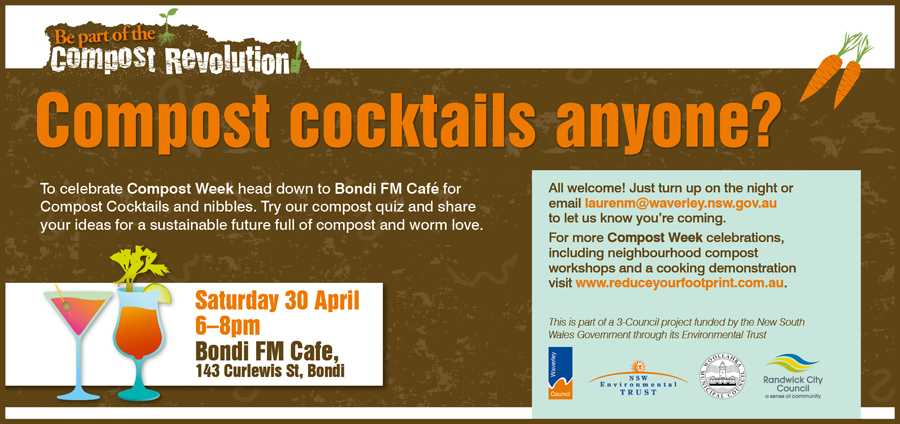
To celebrate Compost Week head down to Bondi FM Café for Compost Cocktails and nibbles. Try our compost quiz and share your ideas for a sustainable future full of compost and worm love.
Bondi FM Cafe, Curlewis St, Bondi
When: April 30, 2011, Saturday 30 April, 6-8pm
View full invite click here
More details click here
 Food Connect Sydney is a social enterprise that links farmers with city folk. It sources organic and chemical free produce from local farms within five hours of Sydney. Food Connect Sydney Subscribers receive a weekly box of fruit and vegetables that is picked up from a City Cousin in your neighbourhood.
Food Connect Sydney wants to challenge conventional, profit-driven food supply systems and to become thought leaders in the fresh food market, providing consumers with food with integrity.
Their aim is to challenge people to:
- think about where their food comes from
- what food quality means to them and
- the impacts of chemical farming on their health and that of the farmers and the natural environment
According to the NSW government: "In Australia, the food supply chain is responsible for approximately 23 per cent of Australia’s total greenhouse gas emissions, making it the second-highest emissions generating activity after power stations. This includes direct emissions from agriculture, and those attributed to energy, transport, food production, processing and distribution."
Read there full acticle HERE
 After a hot, still day parts of the city can be up to seven degrees hotter than the surrounding countryside. Dr Andrew Coutts, of Monash University's Centre for Water Sensitive Cities, says a phenomenon known as the ''urban heat island'' effect means that built-up zones are often warmer than rural areas, particularly after dark.


